
By Texas A&M College of Veterinary Medicine & Biomedical Sciences
The first school for Seeing Eye Dogs was opened on Jan. 29, 1929 in Nashville, Tenn.. Following a short-lived program in Germany after World War I, this guide school trained dogs to assist those in need, and since then has influenced programs all over the world, including the Texas A&M’s Aggie Guide Dogs and Service Dogs (AGS).
Today, service dogs are exposed to very thorough and extensive training, and their duties can extend much farther than assisting only the blind.
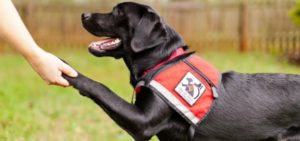
“When people see a service dog in a vest, they automatically think it’s a guide dog. When in reality, a huge percentage of service dogs assist people with all sorts of other medical, physical and emotional things,” said Dr. Alice Blue-McLendon, faculty advisor for AGS and Clinical Assistant Professor at the Texas A&M College of Veterinary Medicine & Biomedical Sciences.
Some examples include mobile assistance dogs, which help people who have trouble getting around due to cerebral palsy, severe arthritis, or other conditions, and hearing dogs, which help the hearing impaired by responding to sound with a certain behavior. For instance, when they hear a knock at the front door, they might be taught to go sit in front of the person to alert them.
“Mobility assistance dogs can even be trained to do things such as push an elevator button, open and close doors, and even pick up car keys and credit cards off of the ground,” said Dr. Blue-McLendon.
Another type of service dogs that have recently become popular are PTSD dogs, or “emotional support.” These animals are taught a wide variety of skills to assist people suffering from post-traumatic stress disorders, and are often aids to veterans.
As you can imagine, these service dogs must go through vigorous training in order to learn and perfect the necessary skills to help their owner. For AGS, Dr. Blue-McLendon explains that there are two stages of training the dogs must complete.
“They usually don’t start formal training, or ‘Stage 2’ training, until they’re about a year and a half years old, “ said Dr. Blue-McLendon. “During formal training, they’re matched with a partner that’s a good fit for the dog’s ability and personality. This stage can take anywhere from 3-6 months, and they will still need continual training and skill reminders for the remainder of their lives.”
Before they enter stage 2, the puppies must earn “jacket privileges,” which are achieved through the different stages in their training. “Some of the first jacket privileges are going to classes and retail stores, and the last one they achieve is going to restaurants,” said Dr. Blue-McLendon.
As animal lovers, it is very tempting to go up and pet a service dog when they are nearby. However, it’s important to remember that service dogs are not pets, and approaching them may distract from performing their important tasks. If you want to learn more about the dog, politely approach its owner, who can then give you further direction.
Leave a Reply